Sunday, 12 April 2009

The Man Who Knew Too Much (Alfred Hitchcock, 1956)

Conventional wisdom has it that Hitchcock never made a bad film. Conventional wisdom also has it that you should never revisit the scene of a crime. Here, both are overturned in Hitch's remake of his 1934 film of the same title.
The action of the first part is relocated from Switzerland to Morocco, but to no great purpose as the screen time is largely eaten up with fake backdrops, even when the characters are walking. Then we're launched into a nonsense plot where James Stewart gets told a couple of names by a shot Frenchman, and his son gets kidnapped so that he'll be persuaded to part with his secrets, which are to espionage gold what alphabetti spaghetti is to Italian cuisine. And Doris Day gets to sing Que Sera, Sera, just because she's there. Several times.
Any hope of suspense is undermined by a laughably flimsy plot in which the protagonists trot from A to B for no particular motive. And to add to all this, it isn't even witty. Avoid like the plague and watch Vertigo for the umpteenth time instead, if you must.

3/10
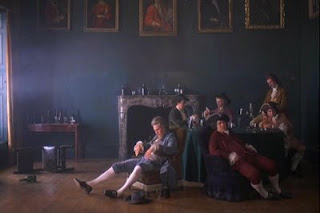
Barry Lyndon (Stanley Kubrick, 1975)

In some way, Barry Lyndon, an adaptation of Thackeray's meandering novel about the rise and fall of a nobody in 18th-century Europe, has become one of Kubrick's forgotten works in the eyes of the viewing public while remaining high on critics' lists for its singleminded artistry. Kubrick really went method with this one: he insisted on nothing but natural illumination - candles for interiors if needed - and even got his leading lady to stay out of the sun before filming to achieve a period aristocrat pallor without make-up.
And somehow it worked: it's a visually luminous piece, composed of shots every bit as carefully framed and lit as paintings. It turns the otherwise wet blankness of Ryan O'Neal in the lead into a sullen determination entirely in tune with the guarded opportunist of the novel, unreliable and out for his own gain yet sympathetic simply because his aspirations are so understandable, refusing to accept his lowly lot in society and moving through the sneering strata with a dogged sense of purpose. Also, given the change of medium and thus the addition of the visual element to how we see the anti-hero, Kubrick wisely did away with Redmond Barry as narrator of his own life, adding Michael Hordern's avuncular tones instead and with this a degree of welcome wryly detached amusement to his trials and tribulations.
The whole is further enriched by a stately and melancholic score of Vivaldi and Schubert, and while it may leave little emotional residue, three hours slip by quite unmarked.

9/10

Sunday, 5 April 2009

Fido (Andrew Currie, 2006)

You know you're not in Kansas any more when you find yourself describing a zombie comedy as perfectly pleasant. But zombie films have pretty much done the whole cycle by now: what started as horrific in Romero's Night of the Living Dead had already become darkly satirical by his follow-up, Dawn of the Dead, until Shaun of the Dead completed the journey into graveyard slapstick. Parallel to this development, the idea of wholesome American suburbia of the '50s teeming with repression and sexual undercurrents has become familiar currency and has proved a rich vein for comedy, such as in the recent Pleasantville.
Fido basically marries the two, and makes the most of the idea of domesticated zombies (read: the non-WASP underclass) amongst the manicured lawns and white fences. Sadly, there's only enough mileage in this for one of those jauntier episodes of The Twilight Zone. Still, it potters along affably, occasionally raising a grin if never a guffaw, and leaving plenty of time to ponder what on earth Billy Connolly is doing shuffling away under all that make-up as the titular faithful homehelp zombie. But it could really have done with the rasping edge of Parents or the more winged fantasies of Tim Burton or Terry Gilliam.

5/10

Saturday, 4 April 2009

The Oxford Murders (Álex de la Iglesia, 2008)

Every so often there comes a film with ideas so laughably above its station that it can only be designated a curate's egg. This particular one never made the UK cinemas but could just as well have, since its determined attempt to cultivate an air of intrigue amongst the fusty backdrops of a picturebook Oxford and relentless namedropping of philosophers and mathematicians, the protagonists selflessly summarising such references for our benefit alone, would make a Da Vinci Code viewership feel right at home.
Elijah Wood reprises his feisty and nervous Yank at sea from Green Street as a student attempting to curry favour with his crotchety academic idol, John Hurt, amidst a chain of murders which apparently have a higher design (cue the theorems). Various women proceed to throw themselves on him for inexplicable reasons, only pausing for breath to deliver already lumbering lines even more woodenly than our hero. Yes, it's a rare treat to watch an Elijah Wood film in which he stands out as positively multifaceted. Or an atrociously ham-fisted murder yarn set in Oxford which wasn't made by a British director.
De la Iglesia and his writing partner-in-recidivism Jorge Guerricaechevarría (remember Acción Mutante?) must be in cahoots with the likes of Woody Allen in some fifth column aiming to thoroughly mangle Britain as a setting for whodunnits for once and for all. Is this finally revenge for what Michael Winner did on his Godzillaesque stomps across Europe in the '60s and '70s? Mercy!

2/10

Thursday, 2 April 2009

El Orfanato (Juan Antonio Bayona, 2007)

Bayona's directorial debut treads well-worn terrain with the story of a child's mysterious disappearance from the house that was his mother's childhood orphanage. The mother becomes progressively more obsessed with recovering her son, and open to supernatural suggestion. What follows is a refined execution of a staple horror formula, the key emotional trigger the refusal to accept the loss of a child, and the narrative impetus a chain of discoveries that all is not as it seemed.
It's beautifully shot and sharply edited, without excessive recourse to histrionics, and Belén Rueda (who also stood out in Alejandro Amenábar's Mar Adentro) as the mother makes a captivatingly driven focal point. Unfortunately, it lacks the defter surprises of Amenábar's The Others, with which it strongly shares its setting, and therefore rarely unsettles as the best in psychological horror can.

6/10

Wednesday, 1 April 2009

Mysterious Skin (Gregg Araki, 2004)

Araki continues to dissect the dramas of ordinary lives through the filter of sexuality as two boys undergo a traumatic experience at an early age and recoil from it in vastly differing ways, one by treating his body so cheaply as to prostitute himself, the other through an obsessive belief in having been the victim of an alien abduction.
The drama is low-key and the set-ups of violent clients and moments of erotic catharsis are familiar from numerous gay and straight takes on alienation and prostitution. But the director's touch is pleasingly light and Joseph Gordon-Levitt, once the sarky little teenager in Third Rock from the Sun, gets to display a growing control and maturity in the role of the emotionally deadened Neil. Comparisons to Heath Ledger might already have been touted even without the uncanny physical resemblance: it's an impressive performance of cocksure fragility.

6/10

Anatomy of a Murder (Otto Preminger, 1959)

This is a superior court-room drama that wears its age well, greatly aided by the worldly cynicism permeating every level of the proceedings.
James Stewart plays a subtle variation on his standard Voice of Decency as a lawyer defending an army officer attempting to evade a murder charge following his wife's rape by the victim. Stewart's golden boy screen persona was already so dyed-in-the-wool by this stage that it comes as a creeping feeling of discomfort to realise that here he's really only out for sticking it to George C. Scott's big-city prosecution counterpart rather than having any interest in justice being done. The script, too, treats the potentially grim topic with flippant insouciance and without ever encroaching on melodrama, far more concerned with milking the interplay amongst an array of equally witty characters for alll the laughs it can squeeze out. It's actually very funny in a gallows-type way and well served by a fine cast, rounded off by Ben Gazzara as the calculating accused and a young Lee Remick as his coquettish wife.

8/10