Wednesday, 21 June 2017

The Rover (David Michôd, 2014)

More truly unpeopled and hostile to life than any part of America, the Australian Outback is a fertile setting for dystopias where civilisation has collapsed, first seized on by Mad Max, of course, and this could almost be in the same universe as that series. Guy Pearce, building on an uncompromising character transition from pretty boy to grizzled Man with No Name, the latter more or less first seen as his outlaw in Hillcoat's The Proposition, is a tormented man with no apparent remaining purpose to live who goes off on a violent mission of vengeance after men who have stolen his car. Along the way, he picks up Robert Pattinson's twitchy, borderline halfwit criminal and the story proceeds in as direct a line as an Outback road to bloody retribution. Spartan and relentlessly nihilistic, it offers no redemption whatsoever, but does maintain a certain integrity in its refusal to fetishise.

6/10

Sunday, 11 June 2017

Hundraettåringen som smet från notan och försvann (Felix & Måns Herngren, 2016)

The 101-Year-Old Man Who Skipped out on the Bill and Disappeared follows the further adventures of centenarian Allan Karlsson and his entourage as they go on a hunt for the formula for the world's best soda, which he lost some forty years before while still a double agent for the Americans and the Soviets. Cue flashbacks to the 'seventies, with characters such as Brezhnev and Nixon, in between scooting around from city to city in the modern day to the incessant accompaniment of a parping Kusturicaesque soundtrack. The comedy is as broad as before and its insistence on the hilarity of the proceedings grates at times, but, just as before, its blithe irreverence for decorum and daftness ultimately save the day.

6/10

Thursday, 8 June 2017

The Girl with All the Gifts (Colm McCarthy, 2016)

It's another day in zombieland, which is now more familiar to us than any country with the possible exception of our own. A second generation of infected children who have normal human intelligence is being reared at an army base in the wake of the collapse of civilisation, and when the base falls it's one of them that holds the hope for a possible cure to the plague. What then follows is the attempt by her teacher, a scientist and a bunch of soldiers to take her across the country to shelter, dodging the screeching undead all the way.
It's impossible to have anything truly new in the genre any more, so we have to feed on what scraps we can. In those terms, a big-name cast of Glenn Close, Paddy Considine and, er, Gemma Arterton offer dependable support and the tension is well maintained. But ultimately, it's the stunning vision of a ruined London with its gutted high-street shops that is the real star.

5/10  

Wednesday, 7 June 2017

Alien: Covenant (Ridley Scott, 2017)

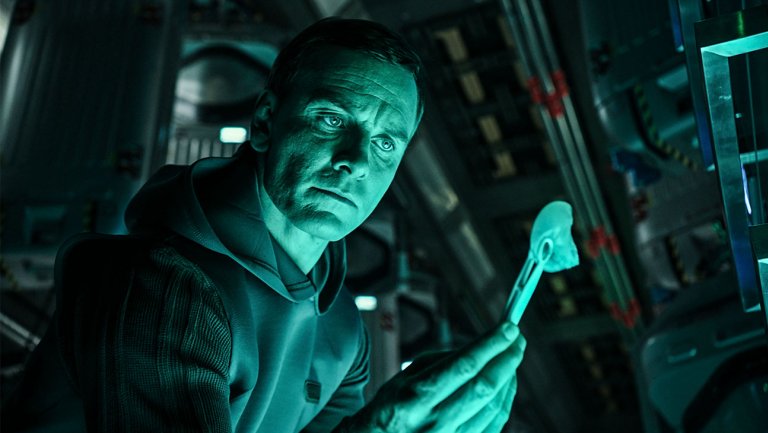
It would have been better to pretend that this was another not-Alien film like Scott did with Prometheus, because it adds as little to the saga as the Predator cross-overs, and is quite easily the weakest one in the series proper. At least the touch of Jean-Pierre Jeunet lent some novel demented twists to Alien: Resurrection. This is just painfully derivative, with a nondescript crew blundering idiotically into peril at every juncture to die in droves. It is somehow undeservingly kept afloat by Michael Fassbender playing a twin role as David, sole survivor of the last film, who has now become a mad-scientist psychopath, and his human-serving counterpart. Sure, the knee-jerk thrills are still there, but what we were supposed to get was the plot moved on further towards discovery of the purpose behind our creation, which the ending of Prometheus meretriciously promised, not just a slasher with high production values.

4/10

Monday, 5 June 2017

War on Everyone (John Michael McDonagh, 2016)

Roughly Starsky & Hutch put through a Bad Lieutenant filter, what we have here is two wise-cracking corrupt cops who, in between cracking skulls and getting drunk, philosophise on random topics in the manner of men learning a page of an encyclopedia every day. It's quite convinced that its irreverence is a colossal virtue and, granted, that does keep you watching, but the duo are nowhere near as charming as they should be to justify rooting for them. It's to The Nice Guys what Family Guy is to The Simpsons, a grossed-out derivative with added pop culture references, though the comparison falls down in that Family Guy frequently hits the comic sweet spot too in a way that its predecessor couldn't. War on Everyone makes do with just offending more minorities and sensibilities instead.

4/10 

Captain Fantastic (Matt Ross, 2016)

Viggo Mortensen makes a good son of the soil as an earth father raising a gaggle of children in the wilds alone after the suicide of his wife. It's an idyllic hippy commune of sorts, the children growing up preternaturally book-smart and politically indoctrinated against the capitalist system, but what droves of critics seem to have missed entirely is how the target of criticism isn't just the orthodox system, but also the father, who is given many of the attributes of a cult leader, albeit a benevolent one. His is the only voice that counts and the children repeatedly trot out dogma that they cannot possibly understand the full import of. The status quo cannot endure and is duly put to the test when they have to venture out into the world to travel to the mother's funeral, meeting hostility from the mother's conservative parents, who refuse to accept the lifestyle choice imposed on their grandchildren.
It's by no means a perfectly-realised piece, with unsteady jumps in tone from escapades and satire, often broad, to attempting to make earnest points about parenting and unconventional ways of living. In that sense, Weir's The Mosquito Coast, its harsher obvious precursor, was a more complete work. But it has a sustaining optimism and vitality that carries it over the choppier waters in the end.

6/10

Sunday, 4 June 2017

Atmen (Karl Markovics, 2011)

A 19-year-old serving time at a juvenile detention centre for a murder five years before is attempting to secure his release through work placements, which his sullenness and pent-up anger prove a hindrance to, until working as a mortuary attendant starts to open up his eyes to the point of life.
Breathing is a dour, ascetic affair, with the camera's constant focus on the nonreactive, nondescript lead bearing a large responsibility for this. However, it is also resolutely set against indulging in melodrama, even at cathartic junctures where greater expression would usually be expected and excused. It treads a singular path, preaching us nothing, just taking pains to faithfully present the dog end of life as it is for some.

6/10